
Object Record
Images
Additional Images [5]
Metadata
Title |
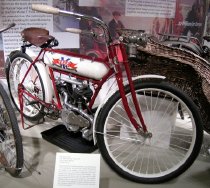
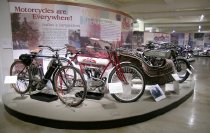
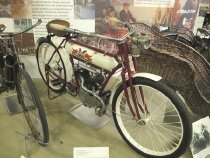
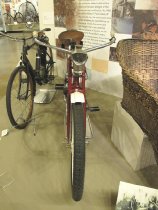
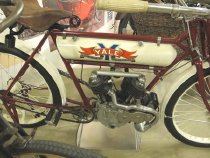
Motorcycle, YALE, 1910 |
Artist |
The Consolidated Manufacturing Company, Toledo OH |
Date |
1910 |
Object Name |
Motorcycle |
Material |
Metal, rubber, glass, leather |
Dimensions |
H-42 W-29 L-84 inches |
Description |
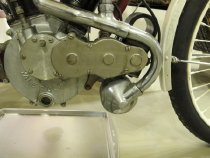
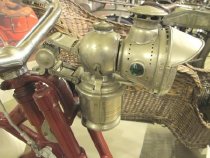
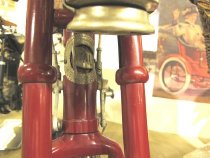
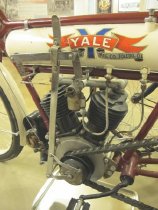
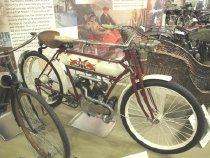
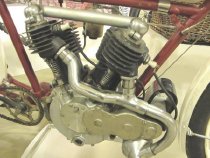
Yale Twin, Serial # 96, 1910 The Consolidated Manufacturing Company, Toledo, Ohio Gift of Esta K. Manthos 2007.28 This motorcycle, built by Toledo's Consolidated Manufacturing Company, is one of the earliest v-twin-engine motorcycles ever produced, and its origins can be traced back to the "moto bicycle" developed by Roy C. Marks. Marks'1896 internal-combustion-powered motorcycle was the first of its kind in America. Formerly of Toledo, Ohio, Marks had moved to California in the 1890s to continue his work developing engines for bicycles. In 1901, the newly formed California Motor Company in San Francisco began manufacturing his "moto bicycles," and by 1902, Marks was awarded two patents. One year later, the California Motor Company garnered national attention when George A. Wyman, riding a 1.25-horsepower "California," became the first person to complete a transcontinental trip across the United States on a combustion-powered vehicle. Departing from San Francisco on May 16, 1903, Wyman arrived in New York City fifty days later, having pedaled the last 150 miles after his bike took a beating crossing desert and mountain ranges. Not long after this historic ride, shareholders of the California Motor Company sold out to Consolidated Manufacturing Company of Toledo, Ohio. By 1906, Consolidated Manufacturing was producing the Yale-California "moto bicycle" which by then had evolved into a truly sturdy motorcycle. In 1909, "California" was dropped from the model name, and by 1910, Consolidated was producing v-twin Yales equipped with an oil pump and a 1.5-gallon fuel tank. The motorcycle weighed 190 pounds (a big machine in its heyday), and sold for $300. Pedaling was the way to start this motorcycle, and ignition was by a Bosch Magneto. It reached a respectable 45 mph and was heralded as a "gentleman's machine." Consolidated Manufacturing continued producing motorcycles until 1915, but like so many other companies of the day, the advent of WWI prompted its shift to war production. By the end of the War, the company closed, having sold its remaining bicycle line to Davis Sewing Machine Company in Dayton - the very same company contracted by Indian and Harley-Davidson to build their bicycles once the two focused exclusively on the manufacture of motorcycles. |
Credit line |
Esta K. Manthos |
Accession # |
2007.28 |
Object ID |
WMSH-2007.28 |
Collection |
Lyman and Merrie Wood Museum of Springfield History |